
 POH
POHYour aircraft's POH
The certified manual for your tail number. Performance numbers, limits, emergency procedures, fuel system, weight and balance. We index the exact POH for the aircraft you fly.

Every decision behind this product traces back to one question. Does this help a real pilot make a safer call in the cockpit. If the answer is no the feature does not ship.


Our story
We started PilotGPT because the answers we needed mid flight lived in three different places. The POH was in a flight bag. The regulation was buried in a 700 page PDF. The weather was scattered across half a dozen briefer pages.
None of that helps when you are 1,200 feet above the ground on a warm afternoon trying to understand whether a gust front is going to beat you to the runway.
So we built one place. Trained on your aircraft. Trained on the regulations. Connected to live weather. Honest when it does not know.
Safety is not a marketing line for us. It is the only reason this product exists.
What we read
PilotGPT never invents aviation knowledge. Every answer is grounded in documents the FAA or your aircraft manufacturer published.
POHThe certified manual for your tail number. Performance numbers, limits, emergency procedures, fuel system, weight and balance. We index the exact POH for the aircraft you fly.
FAAThe full 14 CFR. When you ask about currency, alternates, oxygen, or experience requirements the answer comes from the actual rule.
FAAThe Aeronautical Information Manual plus the Pilot's Handbook of Aeronautical Knowledge. Procedures, airspace, aeromedical, all sourced from the FAA's own books.
FAAHundreds of ACs cited where they apply. If a question touches an AC the answer references it directly.
FAASectional and approach plates indexed for every public airport. 21,808 charts and counting, refreshed every cycle.
FAAFrequencies, runway data, fuel availability, services. Sourced from the official Chart Supplement so the airport data you read matches what is on file.
Live data
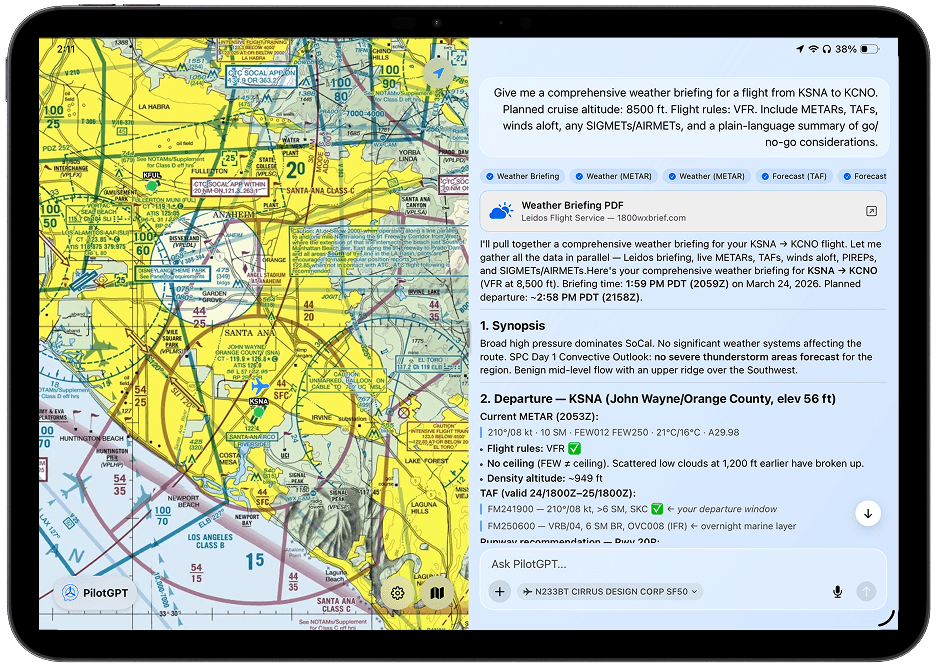
We pull from the NWS, the Aviation Weather Center, the FAA SWIM feed, regional meteorological services around the world. The freshest reading wins. The stalest source gets dropped.
Every source is monitored. If a feed goes stale we route to a backup automatically. If every feed for a region is stale we tell you.
Route planning
Not a generic suggestion. Not a guess. Routes are built from official airway data, current TFRs, terrain clearance, winds aloft, your aircraft's true airspeed and fuel burn.
Pick departure and destination. We build the leg with terrain clearance above MEF, weather along the route, airspace warnings, fuel stops if you need them. Wind correction comes from live winds aloft.
Airway preferred routes, current AIRMETs and SIGMETs, freezing levels, alternates with weather that meets the regulation. The route you file is the route the system would file for itself.

V speeds, fuel burn at altitude, climb performance, gross weight. Pulled from your POH the first time you upload it. Every plan respects your real numbers.

If a leg crosses a TFR you see it. If the alternate does not meet 91.169 you see it. If terrain margin is tight you see it. Warnings are loud on purpose.
Training loop
Our model retrains every single day. Every thumbs down on an answer goes into a queue our team reviews the next morning. The next iteration of the model knows the fix.
01Any question. POH. Weather. Regs.
 02
02Thumbs down if the answer was off.
03A real engineer reviews the failed answer.
 04
04The next training run carries the correction.
Honesty
If the model is not confident in an answer it tells you. That same uncertainty pings our backend in real time so we can fix the gap before the next pilot asks.
PilotWhat is the single engine ceiling on a Tecnam P2006T at 3,000 pounds gross?
PilotGPTI don't have a reliable figure for the P2006T single engine service ceiling at that weight in my current sources. I would rather tell you that than guess. Our team has been notified. Check Section 5 of your POH for the certified number.
A copilot that admits uncertainty is safer than one that confidently invents an answer. We made the choice on day one.
ATC transcription
Real VHF AM audio. Real pilots and controllers in the loop. We are honest about the time it takes to make it bulletproof.
Our dataset is real VHF AM audio transcribed by working pilots alongside working controllers. Not synthetic. Not crowdsourced from outside aviation. Every label was checked by someone who flies or talks to airplanes for a living.

The transcription model runs on your device. No cell signal required. No latency from a server in another time zone. The transcript appears as the controller speaks.
We are honest about this. Real world ATC audio is one of the hardest problems in speech recognition. Noisy carriers. Mic clip. Accents from every country. Mixed numbers and letters at machine gun pace. We will keep training it until it is bulletproof. That is going to take time.
The transcript is an assistant, not a substitute. You still listen to the controller. You still read back. We say this on every screen because it is true.
Community
A forum where pilots tell us what is missing, what is broken, what they wish the copilot could do. We read every post. We ship most weeks.
Asked for a winds aloft overlay on the planner. Shipped two weeks later.
James T.Piper Cherokee 140Flagged a wrong V speed for my aircraft. Fixed in the next training run.
Cassius K.Mooney M20JSuggested an offline mode for the POH search. It is live now.
Lily C.Cirrus SR22The bigger picture
A widely deployed consumer model from a major lab once answered that 9.11 is greater than 9.9. That answer ran for weeks before anyone noticed.
We treat that story as the floor, not the ceiling. Large language models can confidently produce wrong numbers. They can compose convincing procedures that do not match the rule. They can blend a real POH section with one from a different aircraft.
So we built the opposite. A model that retrieves the rule before it speaks. A model that quotes the section it pulled from. A model that flags its own uncertainty. A model that gets retrained against its mistakes every single day.
That is the work. That is the only work that matters in aviation AI.
 Ready when you are
Try PilotGPT for a week. If it does not earn its place on your kneeboard cancel any time.
Questions