METAR & TAF 8N2
8N2 does not publish a METAR.
Showing the nearest reporting station: KVYS (ILLINOIS VALLEY RGNL-WALTER A DUNCAN FLD) · 16.4 NM away. Conditions at 8N2 may differ.
METAR · KVYS
Observed 22:20Z
KVYS 252220Z AUTO 17004KT 10SM CLR A3032 RMK AO2
- Wind
- 170° @ 4 kt
- Visibility
- 10 SM
- Temp / Dew
- —
- Altimeter
- 30.32 inHg
- Clouds
- CLR
- Density alt
- —
- Ceiling
- Unlimited
- Rules
- VFR
Airport info & contacts
Manager on record, flight service, ARTCC, attendance schedule and pattern altitude — published by the FAA and refreshed every 28 days.
Location
- From city
- 4 NM NE
- VFR sectional
- CHICAGO
- ARTCC
- ZAU · CHICAGO
- NOTAM facility
- IKK (NOTAM-D)
Airport manager
- Name
- ROOK NELSON
- Phone
- 815-433-0000
- Address
- 3215 E. 1969TH RD, OTTAWA IL 61350
Flight service · Hours
- FSS IKK
- KANKAKEE1-800-WX-BRIEF
- Attendance
- 0800-DUSK
Frequencies
Tap any row to copy the frequency to your clipboard.
Runways & pattern
Full pagePattern entry · RWY 21
RIGHT TRAFFICAirport sketch
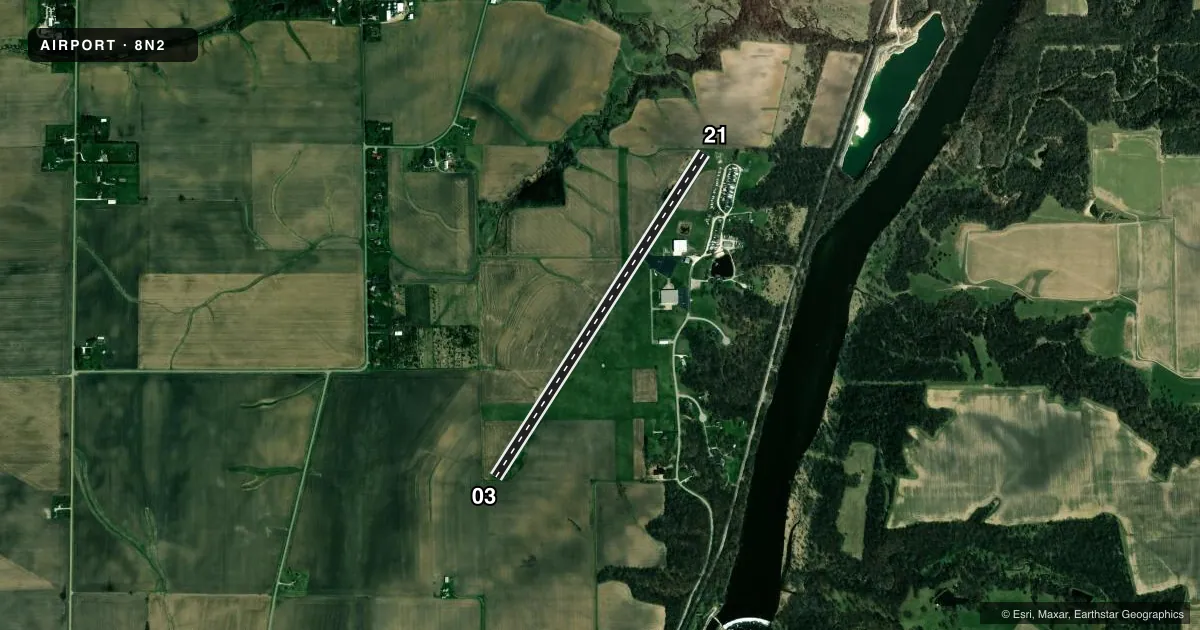
Runways drawn to scale from FAA survey coordinates, rendered over satellite imagery. Not for navigation.
Approaches & charts
Services on the field
Fuel grades, oxygen, maintenance, ramp storage and lighting — as declared to the FAA by the airport operator.
Fuel & services
- Fuel
- Not available
Ramp & ground
- Transient storage
- Tie-down
- Hangar
- Landing fee
- Yes
- Lighting schedule
- SEE RMK
- Wind indicator
- Lighted
- Segmented circle
- No
Fuel & FBOs
Cheapest 100LL and Jet A on the field and nearby. Always confirm with the FBO before taxi.
Airport notes
Surface conditions, obstructions, local procedures, lighting outages and other notes published with each FAA cycle.
General notes
- 268 FT CELLULAR TOWER 1/2 MI WSW OF RY 03.
- FOR NOISE ABATEMENT FLY WIDE PATTERN RY 03.
- EXTENSIVE PARACHUTE ACTVTY ON & INVOF ARPT.
- FOR CD CTC CHICAGO ARTCC AT 630-906-8921.
Lighting notes
- ACTVT LIRL RY 03/21 - 122.725
Approach & departure obstructions
- 037 FT CROPS 68 FT FROM RY END
- 217 FT SHRUB 67 FT FM RWY END.
Other notes
- THIS AIRPORT HAS BEEN SURVEYED BY THE NATIONAL GEODETIC SURVEY.
- PRVDD THE AREA 125 FT EITHER SIDE OF RY CNTRLN & 200 FT OFF RY ENDS IS CLEAR; ANY OBSTN REMOVED/LOWERED OR THLD DSPLCD TO PRVD A CLEAR 20:1 APCH; AREA 60 FT EITHER SIDE OF RY CNTRLN & 240 FT OFF RY ENDS IS CLEAR.
- MANAGEREMAIL ADDRESS: ROOK@SKYDIVECHICAGO.COM (ALL LOWER CASE)
VFR map & nearby airports
VFR sectional. Tap any ICAO chip to open that airport.
Key facts · 8N2
Answer card- ICAO
- 8N2
- Name
- SKYDIVE CHICAGO
- Location
- OTTAWA, ILLINOIS
- Elevation
- 616 ft MSL
- Traffic pattern altitude
- 1,616 ft MSL (1,000 AGL)
- Control tower
- Non-towered (use CTAF)
- Total runways
- 1
- Longest runway
- 03/21 · 4,522 ft
- Published ILS approaches
- 0
- Published frequencies
- 2
- Magnetic variation
- 1°
- Current flight rules
- VFR
- Current wind
- 170° at 4 kt
- Favored runway now
- RWY 21
SKYDIVE CHICAGO (8N2) sits in Ottawa, Illinois at 616 ft MSL. The field has one runway. Runway 03/21 is 4,522 ft long with asphalt pavement. There is no control tower. CTAF and UNICOM are both 122.725. No ILS approaches are published here.
Pattern altitude is not published. Use the standard 1,000 ft AGL pattern for light piston traffic unless the current FAA Chart Supplement or the airport operator gives you something different. The airport has published noise abatement guidance for a wide pattern to runway 03. That matters here because parachute activity is extensive on and near the airport.
Low intensity runway lights on 03/21 are radio activated on 122.725. Published remarks also note a 7-foot shrub near the runway 21 end. They note 7-foot crops near the runway 03 end. A 268-foot cellular tower sits about one half mile west-southwest of runway 03. The field is surveyed by the National Geodetic Survey.
No on-field FBOs are listed in the facts. Contact the airport operator directly or call the field on CTAF or UNICOM for current service details before arrival. If you need clearance delivery, Chicago ARTCC is listed at 630-906-8921. Pilots should plan for active jump operations and keep a close eye on traffic in the pattern.